
Val Verde 72-Hour Release Access
No separate official Val Verde County rolling 72-hour release view was located as of August 2, 2026. The Sheriff homepage is not a release database and should not be relabeled as one. No official field set, update cadence, archive, photograph flag, or web retention period could be verified. The county may still be able to generate an internal report when a requester supplies exact dates.
Three days is useful when an inquiry crosses Saturday, Sunday, a holiday, or an office closure. Yet the window must be defined. “Last 72 hours” rolls backward from a set moment, while “the last three days” may mean three calendar dates. Put local start and end timestamps in writing and say whether both endpoints are inclusive.
A three-day list is an interval report, not a substitute for a named-person search. Ask the custodian to include each qualifying release or transfer event, even when one person had more than one booking episode. Sorting by the actual timestamp helps detect events near midnight. Save the report’s production date because a later export may include a correction.
Request Val Verde Three-Day Releases
Build the request around the report, not assumptions about a missing web feed. If several people share a name, identifiers and booking numbers matter. Since the adult facility holds local and federal populations, the destination and authority fields are central, not optional detail.
- Choose the exact 72-hour period in Val Verde County local time.
- Review the official Sheriff page for current contact details.
- Use the county open-records form to request an electronic export for that interval.
- Request identifiers, timestamps, release codes, cause numbers, authority, and receiving destination if public.
- Ask for the code legend and an itemized cost estimate before charges are incurred.
- Reconcile each important row with the court order and the next custody system.
For only the newest events, use the Val Verde County 24-hour release guide. It explains the tighter rolling-day request and urgent phone check.
Val Verde 72-Hour Report Fields
No claim is made that Val Verde exposes these fields online. They form a careful request based on the county record inventory. The list should show which custody ended, when it ended, why it ended, and who had authority over the next step.
| Field to request | Use in a three-day review |
|---|---|
| Name, date of birth, identifiers | Separates people with the same or similar names. |
| Booking number and intake time | Identifies the custody episode behind the row. |
| Release or transfer timestamp | Places the event within the defined 72 hours. |
| Release type and authority | Distinguishes bond, order, sentence completion, or movement. |
| Court and cause number | Routes the reader to the legal reason for release. |
| Receiving agency or destination | Shows continued custody when that information is releasable. |
Ask for the booking-out sheet and custody chronology when a summary row is unclear. The permanent jail register provides a formal fallback for core release or transfer dates. Detailed release paperwork generally has a two-year minimum measured from release or transfer under Texas Local Schedule PS, subject to holds and the county’s adopted schedule.
Release is not disposition. Bond may end detention while a case remains open. A dismissal may cause an exit only if no other hold blocks it. Time served can end one term while a detainer continues custody. The court order explains the legal event, while the jail timestamp establishes the local physical exit. Retain both dates.
Val Verde Weekend Release Windows
The Sheriff describes office operation as continuous, but separately lists business hours for the public office. That does not prove records staff answer at all hours, establish a daily release schedule, or show where a person exits. No official weekend release procedure, holiday early-release rule, pickup point, or family waiting area was found.
A report requested after a weekend should cover the whole period plus enough identifying detail to detect a late-entered event. Do not move the timestamp to fit a preferred day. Preserve both the actual custody timestamp and the date the report was produced. If a known person is the real focus, the Val Verde County released-inmate guide gives the stronger person-by-person verification chain.
Val Verde Release Verification Routes
Call the Sheriff at 830-774-7513 or the detention facility at 830-778-0096 for the narrow current-custody question. Then obtain written proof. The county form can seek the booking-out sheet, custody history, release order, bond record, and transfer destination. The District or County Clerk record can show the order, judgment, dismissal, or pending case behind the event.
If the report says TDCJ, move to the Texas Department of Criminal Justice search or records channels. If it says USMS, use the federal docket and Marshals route; BOP is most useful once a sentenced person enters that system. ICE and another county each have separate confirmation paths. Texas IVSS-Counties may provide event alerts for participating counties, but Val Verde participation was not verified. An alert is a prompt to obtain the official record, not the official record itself.
A fully discharged former TDCJ prisoner may require the email or formal records route because the live search does not promise permanent display. BOP status is federal-system specific. ICE results concern immigration custody, not the county case. Each source answers only its own agency’s custody question.
Val Verde Release Rows Need Context
The principal facility is described in current corporate material as local and federal detention under a USMS intergovernmental agreement. That mix makes a simple “released” label unusually easy to misread. A local defendant may return to the community on bond. A sentenced person may transfer to TDCJ. A federal detainee may move under USMS authority without ever entering BOP custody at that stage.
Request the release authority, receiving agency, and destination if releasable. Match them to the court cause number. “Transfer” means one custodian’s episode ended; it does not mean confinement ended. Likewise, a person who remains on a current roster has not yet been shown as released, even if a court has signed an order that staff are still processing.
Permanent Val Verde Release Evidence
A public feed, if one later appears, may be brief. Formal records last under separate schedules. Texas Local Schedule PS describes the county jail register as a permanent summary containing core commitment facts and the release or transfer date. Booking-in, booking-out, transport, transfer, and legal release documents generally carry a release-or-transfer-plus-two-years minimum.
The official county records form was successfully captured for this project.
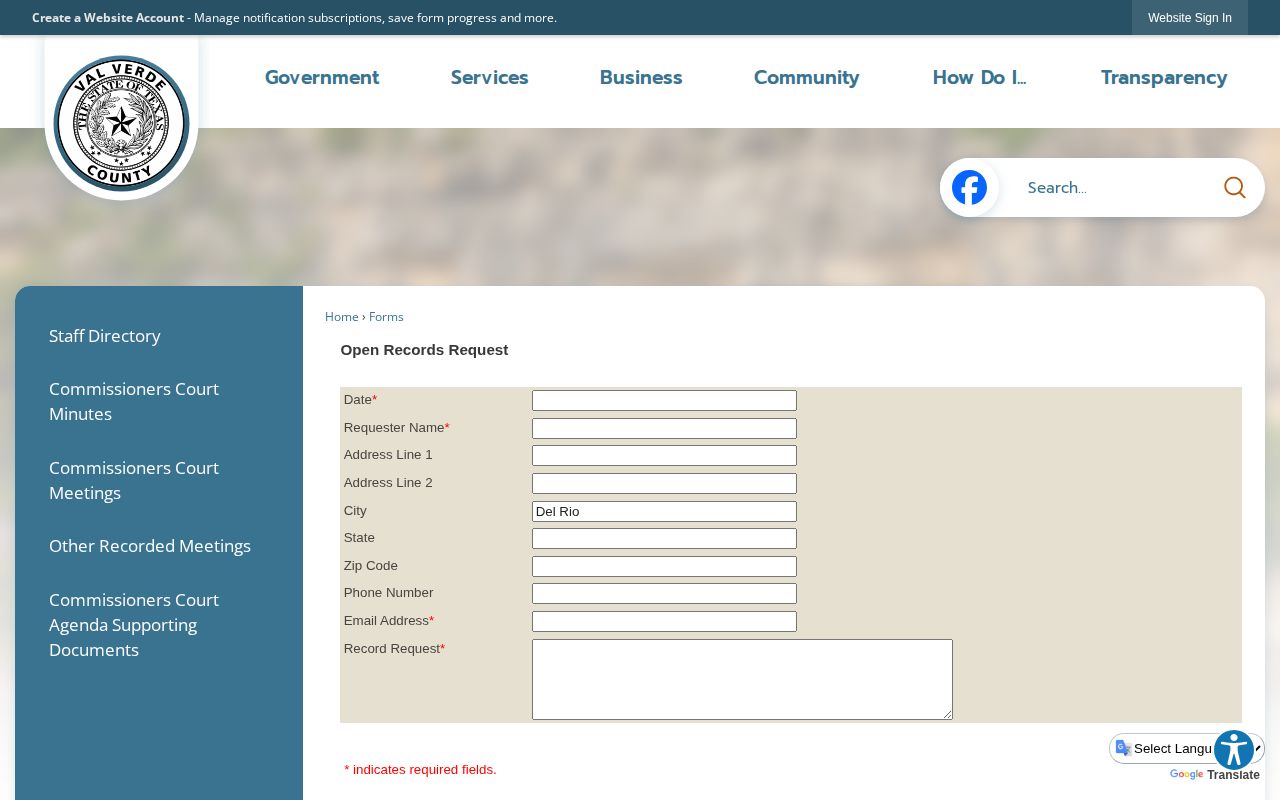
The form supports a date-bounded request when no 72-hour page exists. Sensitive, juvenile, sealed, expunged, victim, medical, security, and active-law-enforcement material may still be withheld.
If detailed papers are unavailable, request the permanent register entry and the court docket, judgment, or order. Ask which adopted schedule and destruction hold governed the reply. Litigation, audits, or investigations can extend retention beyond a minimum. A vanished web page does not prove the formal record is gone.
Review the finished export row by row. Start with the timestamp, then match the booking number and person identifiers. Compare the release code with the custodian’s legend. Use the cause number to locate the order that controlled the event. Last, inspect the receiving-agency field. That sequence keeps the three-day report from becoming a bare list of names with no legal or custody context.
Several gaps should remain explicit. No official Val Verde web cadence, internal report name, photo field, weekend processing time, public release lobby, or property-return method was found. Those are questions for the facility. Facts from another Texas jail should not be imported. If staff supply a current procedure, note the source and date because an operational practice can change sooner than a permanent record rule.
A correction may also arrive after the first request. Preserve the original export, the revised version, and the custodian’s explanation. Do not silently replace one release time with another. Court action, administrative entry, and physical movement can have distinct timestamps, and each may be correct for the event it records.
No official Val Verde 72-hour feed was located, and the Sheriff homepage cannot stand in for one. If a new portal appears, check that it is county-owned and determine whether its “72 hours” is rolling or calendar-based. Also verify whether transfers are mixed with community exits and whether corrected rows replace earlier data.
A well-kept request file should contain the submitted date range, confirmation, cost estimate, custodian response, code legend, and source documents for key rows. This makes later review possible without depending on memory or an unofficial copied list.