
Val Verde Release Date Milestones
A projected date is TDCJ Classification and Records’ current calculation for release from incarceration if parole does not occur sooner. Parole eligibility only marks when Board review can occur. A favorable vote shows Board intent, not a gate exit. Scheduling happens after release-certificate processing and an audit. Actual release is the event that ended physical custody. Discharge is the later end of the full sentence or supervision term.
For a person at the Val Verde County Detention Facility, the source depends on legal authority. A local sentence calls for the county judgment and jail calculation. A transfer to TDCJ ends county custody but continues incarceration. A federal movement under USMS authority calls for the federal docket, then BOP if the person is designated there. A disappearance from one roster cannot supply a projected date.
| Milestone | What it proves |
|---|---|
| Eligibility date | A statutory review point, not approval |
| Projected date | A current calculation that can change |
| Favorable Board vote | Release intent subject to remaining steps |
| Scheduled date | Later operational planning after processing |
| Actual release | Physical custody ended under a stated authority |
| Discharge | The sentence or supervision term ended |
Lookup Val Verde Projected Release
For a TDCJ prisoner, begin with the official offender search. A TDCJ or SID number is the safest key. A name search must be narrowed with age, birth information, sex, race, county of conviction, and offense details shown by the interface. Open the Offender Information Details record and review status, projected release, maximum expiration, scheduled release information if present, and Parole Review Information.
The online search focuses on people still within TDCJ custody or supervision. A person whose sentence is fully discharged may not remain reliably searchable. The TDCJ email channel can return prior or current incarceration history and a projected date at no charge. Send the full name and seven-digit TDCJ number, or exact date of birth, or approximate age with county of conviction. Put the person’s name in the subject.
- Identify county, state, federal, juvenile, or military custody before searching.
- For TDCJ, search by state identifier and verify the matching conviction details.
- Record the projected date, maximum expiration, status, and any scheduled information separately.
- For a county sentence, obtain the judgment, sentence start, jail credit, and jail calculation.
- Check for another sentence, detainer, court order, or transfer authority.
- Confirm actual exit through the release certificate, booking-out record, or originating office.
The captured TDCJ search form shows the official state starting point.
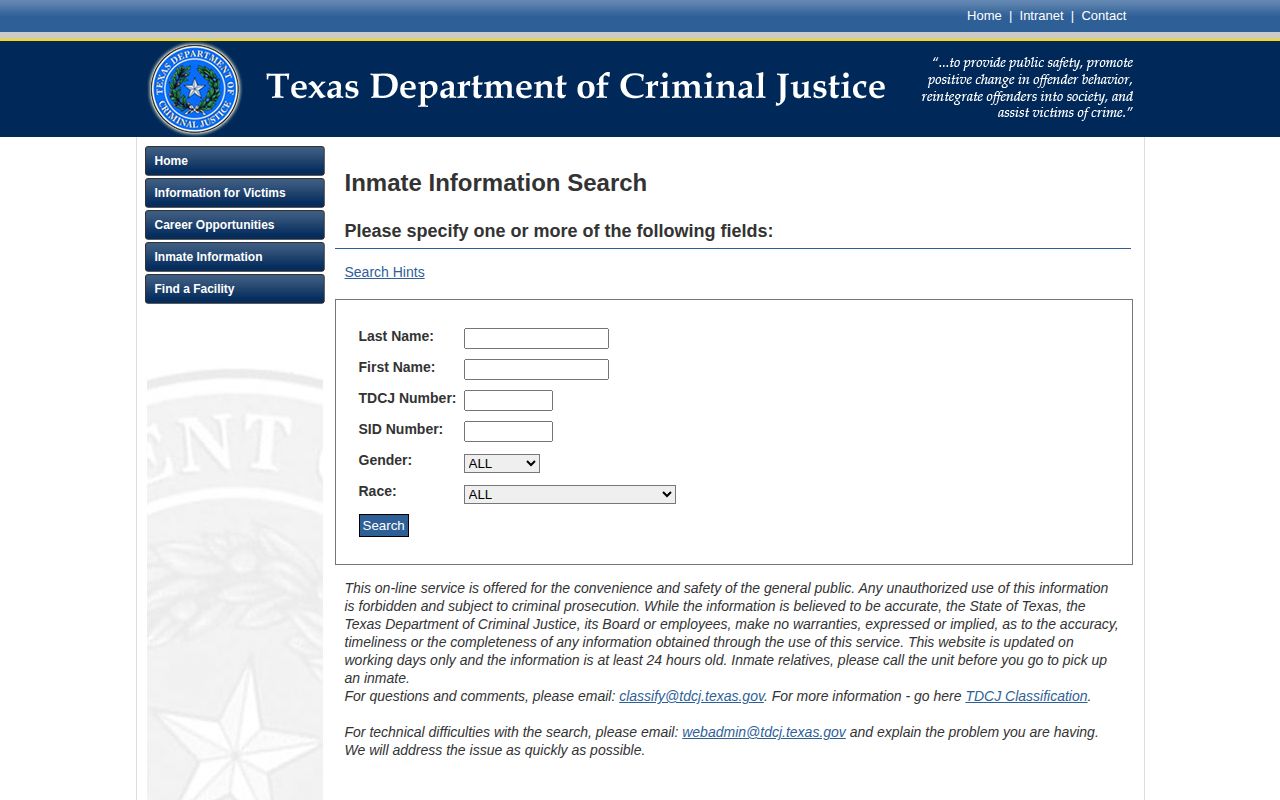
The form supports identity matching, but automated access failed during research and no example record was used to promise permanent coverage of discharged people.
Val Verde County Sentence Calculation
A county jail calculation begins with the signed judgment. Ask for the sentence imposed, sentence-start date, credited jail time, concurrent or consecutive terms, good-conduct classification, credits earned, any forfeitures, and the calculated discharge date. If the judgment says time served, obtain the credited-day finding and the actual booking-out timestamp. Another hold can keep the person confined after the local term ends.
Texas Code of Criminal Procedure Article 42.032 allows a sheriff to grant commutation for good conduct, industry, and obedience. The deduction may not exceed one day for each day of the original sentence actually served when no misconduct charge is sustained. The word “may” matters. It is discretionary and does not prove that Val Verde awards the maximum in each case. Article 42.031 separately addresses qualifying work-release classification.
No sourced Val Verde policy established automatic weekend or holiday release, a public calculation tool, or a set release-processing hour. Do not shift an expected date based on custom. Call the jail and request its calculation. The Sheriff’s Office is at 295 FM 2523/Hamilton Road, Del Rio, and its main phone is 830-774-7513. The detention facility’s separate number in the GEO audit is 830-778-0096.
Note: Pretrial detention has no fixed projected release date because bond, court rulings, case resolution, and holds control exit.
Texas State Release Date Rules
Texas Government Code Chapter 498 governs TDCJ good-conduct time. Section 498.003 creates classifications and accrual rates, while related provisions address loss and restoration. Good time can affect eligibility or a mandatory-supervision calculation. It does not shorten the judicial sentence itself, and it never guarantees release.
Government Code section 508.145 contains several parole eligibility formulas. For many cases, calendar time plus good-conduct time must equal one-fourth of the sentence or 15 years, whichever is less. Certain serious offenses and deadly-weapon findings use actual calendar time without good-conduct credit, generally one-half of the sentence or 30 years, whichever is less, with statutory minimums and special categories. The offense date and precise conviction control. A displayed TDCJ date is safer than home arithmetic.
Texas has no general rule requiring every state prisoner to serve 85 percent. That figure is often drawn from federal rules and should not be imported into a Texas calculation. The aggravated-case half-time framework is about parole eligibility, not a universal physical release date. Mandatory supervision under sections 508.147 through 508.149 also has offense exclusions and Board review for eligible modern cases.
The TDCJ projected-date explanation is captured below as the subject-matched fallback channel.
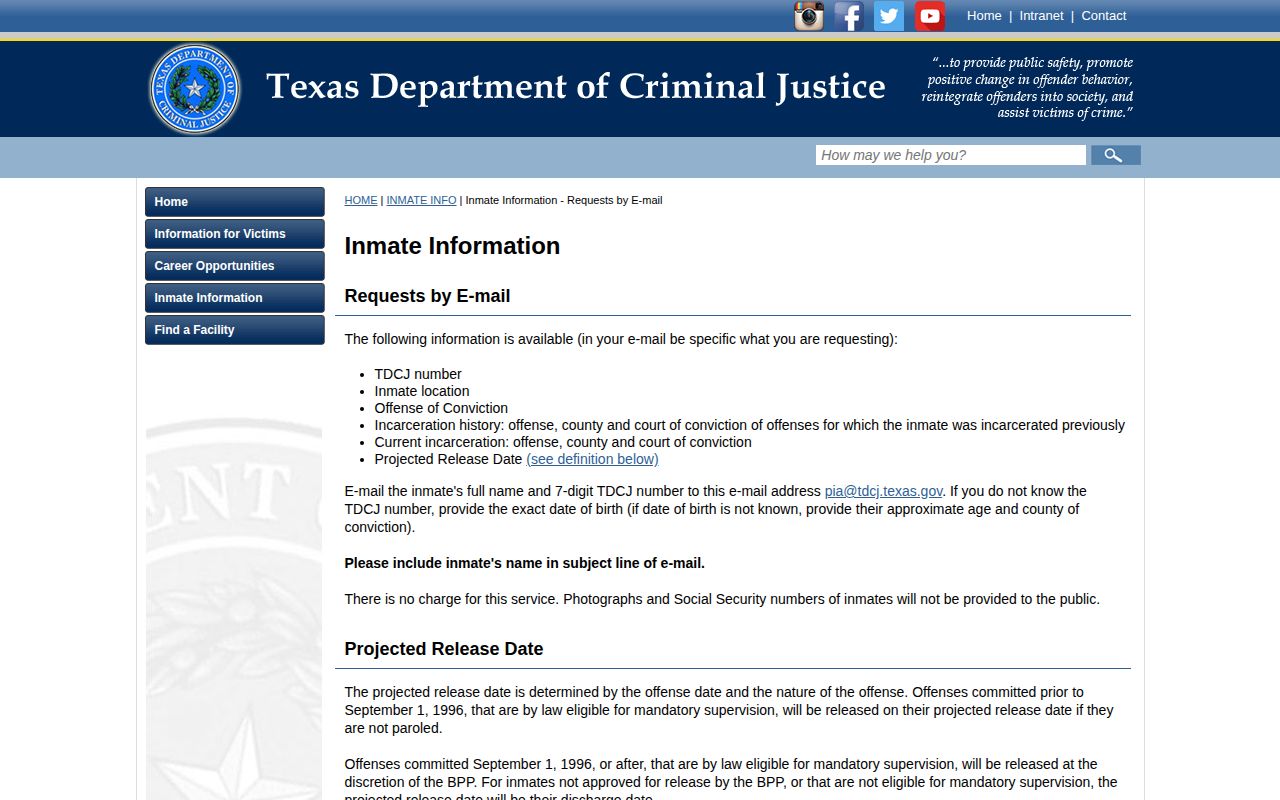
This channel can provide a projection when the live search fails, but it is different from a formal request for the actual release certificate or discharge record.
Why Val Verde Release Dates Change
A projection changes when a fact used in the calculation changes. Compare the new and prior TDCJ record instead of assuming error. Ask Classification and Records which public input changed and preserve the dated response. For county custody, compare the jail calculation with the judgment and later court orders.
| Factor | Possible effect | Best confirmation |
|---|---|---|
| Good-time classification or loss | Moves eligibility or mandatory-supervision calculation | TDCJ calculation record |
| Board approval or denial | May advance release or move projection toward maximum expiration | Parole Review Information and voting code |
| Required program | Can delay release until completion | Current Board code and TDCJ status |
| Detainer or hold | May change destination or prevent community exit | Holding and receiving agencies |
| New sentence or court order | Changes credit, term, or legal authority | Signed judgment or order |
| Audit correction | Revises a prior projected or scheduled date | Classification and Records |
A favorable FI or RMS vote is not the last step. Review and Release Processing verifies the plan, conditions, and programs and issues a release certificate. TDCJ says certificate processing often takes four to six weeks, followed by an audit and date calculation that may take about 14 to 21 business days after Classification and Records receives the certificate. These are process descriptions, not deadlines.
Val Verde Parole-in-Absentia Dates
Val Verde has a key exception for Parole in Absentia, or PIA. TDCJ explains that a person approved while held in county jail is processed much like an institutional releasee, but the person leaves from the county jail. Classification and Records does not calculate or post that county-jail release date on the TDCJ website.
For a PIA case, confirm the favorable Board result and release processing, then contact the Val Verde jail for the actual exit. Do not wait for a projected field that TDCJ says it does not post for this path. A county booking-out sheet, release authority, and TDCJ supervision record together explain the event. The TDCJ parole and release FAQ documents the exception.
This is also why a state parole decision and county release date can differ without conflict. One record documents approval and state processing. The other documents the local physical exit.
Confirm Val Verde Actual Release
After a date is scheduled, check the TDCJ details again and save the wording. Ask for the release certificate or actual release entry. For local custody, request the booking-out sheet, actual timestamp, release type, legal authority, and receiving destination. The Val Verde County release-record path covers those county requests.
Texas IVSS-Counties can send booking, release, court, death, escape, or transfer-to-TDCJ events for participating counties, but Val Verde participation was not verified. A notification is a prompt to confirm, not the official release record. Current registration steps are covered in the VINELink inmate check. Federal cases require the federal docket, USMS, and later BOP as appropriate.
When a county record says transfer to TDCJ, preserve both dates. The Val Verde booking-out date marks the end of the local episode. The later TDCJ intake and projected date describe state incarceration. Intake processing can create a gap before the person is visible online, so use Classification and Records when a documented transfer is not yet returned by the search.
A detainer also changes what “release” means. Another county, federal, immigration, or military authority may take custody when Val Verde’s authority ends. Obtain the name of the receiving agency and the legal order, then use that system. A calculated county discharge date cannot establish community exit when a hold remains active.
For older TDCJ cases, a formal Public Information Act request can seek the release certificate, actual release date, discharge date, offense, sentence, court, county, cause number, and prior incarceration history. Texas Government Code section 552.029 identifies several public fields, while other parts of the classification and parole file remain protected. Accepting releasable portions and redactions keeps the request focused.
If the court docket and custody record show different dates, do not force them to match. A signed dismissal, sentence, or bond order answers the legal question. The jail timestamp answers when physical custody ended. Administrative processing, transportation, another charge, or a separate hold can explain the interval.
Keep every milestone labeled. A TDCJ projection, a county transfer date, and an IVSS alert answer different questions. Only the record from the agency that ended custody proves the actual event.
Val Verde Calculation Contacts
Classification and Records lists 936-437-6231 and classify@tdcj.texas.gov for calculation questions. Review and Release Processing has a separate role after a favorable decision. Using the correct office preserves the distinction between a projected calculation, Board action, operational scheduling, and completed release. Provide the TDCJ number and identity details so staff can match the right record.
Record the date each answer was obtained because a later audit, Board action, or court order may lawfully change the current calculation.